Showing posts with label food drink smoking. Show all posts

Thursday, July 30, 2015

YM Fermentation Week - Sandor Katz

Dance wit' da one who brung us all, Sandor Katz!

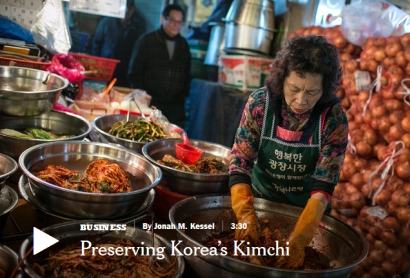
In this GREAT video from the New York Times, you get a real feel for the man who was decades ahead from the rest of us as regards fermenting veggies ...and imparting all that wonderful probiotic goodness to foods that might rot in a bad way!

Do you have his book?  I've had it for years and it is considered the bible of fermentation.

This book will take you through the basics to the finer points of the fermented veggies you know ...to some you've never heard of.

They don't call it the bible for nuthin'.

Get it anyway you can.  If there is a food preservation book that is indispensible, this is it.

Sauerkraut is the gateway veggie to blissful preservation and keeping Vitamin C levels up all winter long way out in the country.

Wednesday, July 29, 2015

YM Fermentation Week - Kimchi

Here's one I haven't tried to make yet, Korean kimchi, calling it the "sauerkraut of Asia" doesn't begin to describe it.  I've always known that it was important to Korean cuisine but I had no idea how important kimchi is to the culture as well.

Wherever Koreans go, kimchi will follow be it in war or the peace of outer space.

I love the stuff and intend to make up a big test batch.  I love this NYT video, too!

Tuesday, July 28, 2015

Watermelons ...then and now!

I hope I can do more of these.  A lot of vegetables have been inbred beyond recognition ...some for better, some for worse.  Examples like this are fascinating at any rate!

Stanchi's watermelon, which was painted sometime between 1645 and 1672, offers a glimpse of a time before breeding changed the fruit forever.

Tuesday, May 12, 2015

Argentine Cheeses: Are We Getting Someplace?

Could the supreme deliciousness of grass-fed Argentine beef have stunted the urge for other flavorful foods here?  Now that it's gone ...could foodie-culture flourish?
My darling wife and I were strolling las callecitas de Buenos Aires today on a few errands ...and we found ourselves in the San Nicolás neighborhood, right across the street from Recoleta.

There's a municipal market there that is a diamond in the rough.  Literally, you could step right by it and dismiss it as nothing special.  Two or three steps in the door, however, and your radar tells you that you are onto something special.
http://www.homestayba.com/#!mercado-municipal-san-nicolas/zoom/c1wln/i44e7v
 It's old and it's wonderful and is protected by the city and the prices can be astonishingly low.  It's right on the Callao subway stop on the D line and eminently walkable from about anywhere in the city's central area.

A lot of the market stalls are empty if you don't get there early ...but even the closed ones are beautiful in a "living museum" way, close spaces with ancient glazed tiles, big refrigerator doors from a by-gone era, old scales and machinery, great thick cutting boards worn inches into their original surfaces by operators in their favorite places.  Old signs advertise things that you just can't get anymore.
Mamon is veal ...which is illegal in Argentina ...but not for any anti-cruelty reasons.
It's open until a little past 7pm and, right up until closing, it is a shopper's delight for fruits, veggies, meats, grains, spices, ...and CHEESES.  I just happened to be looking for a nice melty cheese and my sweetie reminded me of this market.

Wow.  I was dumb-struck, gob-smacked and oh so pleased by a cheese I found in the cheesemonger's case (I even forgot to write-down the name of the stall or take a picture!  No worries, it's on the right, immediately inside the main lobby, forward and to your right.)

https://lodepepe.wordpress.com/portfolio/quesos-rebleusson-de-alta-saboya-a-suipacha/
Queso Rebleusson from Fermier
It was pretty.  It looked like it would melt nicely.  I told my wife that I wanted some and, while I had my back turned, she had finagled a big sample slice for the two of us. Wow, it was good.

The cheese lady told us that it was a type of camembert; it wasn't but I could tell from the smell that the inspiration was there!  It was firm but with a little gooeyness.  So far, so good ...but the taste!  There was real flavor in this Argentine cheese!

I don't trust my taste buds after over a decade in The Argentine.

People are always amazed that I emigrated here from the US; people are always amazed that I've stayed here so long ...I'LL TELL YOU WHAT AMAZES ME: of all the countries on earth, how did I pick the one with the most bland version of western hemisphere food?

At least we USED to have the best beef on earth ...now even that's gone.

When I bit into that cheese I wasn't really sure if I was a good judge of cheese anymore.  So I ran it by my friends in the Argentine facebook group, "Buena Morfa Social Club."  Sure enough, the feedback fed-back immediately.

While "the foodie" may be ready for burial in the US (à la the hippie,) awareness of food is just now blossoming in Argentina.  The Buena Morfa Social Club is a group that started here about a year ago ...it now has well over 12,000 members with no end in sight.  Within an hour, the group sent me enough links and references to the cheese in question to satisfy me that my tastebuds had not atrophied, lo these many years.

Even the cheese lady told me the story of how this particular cheese factory had sent its sons to study in France in order to bring back interesting cheeses.  This is not the Argentina that I grew to love back in 2000.

For example, here's another Argentine website devoted to food, Planeta Joy ...the link was sent to me by the group and, sure enough, it mentioned the cheese I found today.  Not only did the post mention my cheese, it raved about it and how strong it tasted:

Extreme Cheeses: The Strongest of the Shopping Cart
There is a minority of dark palettes that worships mature, aromatic, tasty and powerful cheeses. For them, this post: a tasting of the best examples produced locally.
 Rebleusson: for the audacious
Originally called Reblochon, but the manufacturer, respecting French appellation laws, changed the name to Rebleusson. The crust has a pale orange color, is oily, a semi-soft cheese and when ripe is extremely aromatic, to the point of being stinky in some cases. But this stench is not consistent with its flavor, since taste is less aggressive and has notes of butter and nuts. This shines in the cheese and goes very well with fruity white wines. Perfect gift for a foodie friend or to avenge someone who owes you money by hiding it in a trunk. It is the only example of this cheese in Argentina and Fermier makes it with whole milk from their own Jersey crosses in the town of Suipacha in Buenos Aires province.

Foodie-ism took a long time to take root here ...but it is now here in force.  Now, just like in the US and Europe, ordinary people who have no idea what they are talking about will challenge each other to cyber-duels over foods they have never tasted!

"It's a good thing," as Maya Frost Martha Stewart would say.  We are on our way here in Argentina to more authentic and mindful versions of foods with more of the original flavors of the myriad of immigrants to this bread-basket of the world.

It used to be just beef here. While I lament the passage of that great grass-fed patrimony into history, if its disappearance has resulted in a sudden national craving for other foods with deep distinctive flavors, I'm all for it!

Provecho a todos!

Tuesday, May 05, 2015

Recipe Time at Yanqui Mike: BABAGANOUSH!

(Originally posted January 31, 2011)

I thought that I´d written about this before ...but apparently not.  This is great, tho, for anybody who makes great big wood fires!

After a big asado down on the ranch, there´s always a bunch of coals left over.  What a shame to let them go to waste!

So here´s what I do:  when the season is running for eggplants, I buy a butt-load of them for next to nothing ...then I throw them directly onto the hot, not-flaming embers.  I give 'em 15 to 20 minutes on one side then flip 'em and give 'em another 15 to 20 on the other side.

Ask any Arab, the most important ingredient for babaganoush is roasted eggplant over hardwood coals.

You can do 'em in your oven but the result will be lame and you´ll wonder why anybody even likes the stuff!

That´s the secret.  If you roast your eggplants over coals, you can make a million mistakes and your babaganoush will still be world-class... and you will delight even your friends from The Levant.

The coals burn the skins of the eggplant to a crisp ...but the inside is mushy and lovely and oh so easily scraped from them with a spoon.  The smokyness permeates the otherwise rather tasteless flesh and will make you an eggplant lover ...at least for this purpose.

Now, you got it in the bag!

Scrape the roasted flesh away from the carbonized skin (don´t be afraid of getting a few black flecks into it, they will lend even more proof of wood-roasting) ...it´s OK if some of the flesh is cooked more than the rest ...it adds texture.  Think of it as Arab guacamole.  Everybody´s wife, mother, and grandma makes it a little different and ...like a martini ...everybody swears by their own version ...or their gramma´s.

Then add the requisite additions:

You´ll need tahini, that´s a raw paste made of sesame seeds.  You can buy it in most big supermercados in Buenos Aires ...but they tend to hide it from you in separate "imported food" sections.  Keep looking.  For every 1 to 1½ pounds of RAW eggplant you buy, you´ll need about 2 tablespoons of tahini... mix it in slowly during the whole process to reach the balance of flavor that you like.

For that amount of roasted eggplant, you´ll need ABOUT the juice of 1 medium-sized lime or lemon.  Some people prefer lemon to lime, it won´t make a LOT of difference ...try it both ways and see what you prefer.

Garlic is absolutely de rigueur. This is also to taste but should be about one clove, más o menos, for this quantity.  You can play around with roasted garlic from the same coals ...but adjust accordingly for the reduction in garlicy-ness ...or add some fresh to the roasted to balance it out.

A few pinches of cumin will set YOUR babaganoush apart from the rest ...but the quality of cumin available on the market varies tremendously.  Sometimes the cheapest tastes the best, sometimes the most expensive pulls up lame.  Brand doesn´t seem to matter.  Hit and miss.  Trial and error.  Do your best.

Salt, of course.  Keep in mind your audience ...but keep in mind, as well, that this is a savory dish (or dip) and, since it´s a side-dish, people like a little more salt with babaganoush.

Black pepper or red pepper?  That´s a tough one.  Black is indicated considering it´s origin.  However, Hindus love it too ...and they tend more toward the red (along with a little homemade yogurt!.)  My first choice is black ...but if I can mix it with some red powder like some smoky chipotle ...I´ll do it in a heartbeat.  One great way to present it is: make the recipe with the black ...then sprinkle the chipotle on the top at serving.

NOW ...as to the "herbal component", I think you need freshly chopped parsley ...but just enough to hint at the flavor.  Mint is another option or addition, and a good one, but you´d better be careful not to put anyone off.

For the above quantity of eggplant you´ll need some 3 tablespoons of olive oil.  Choose a strong flavor if you can.  The "angels" of first-pressing, extra-virgin are best left for delicate salads.  Here you need olive oil that tastes like OLIVES.  When you bring it to the table, shmush a little dimple into the resultant pureé ...then fill that with the rest of the olive oil.  Garnishing with fresh mint ...if you´ve left that out, so far ...will most likely delight.

Now go get the best pita bread you can find (no advice on that from me) and dig in.  Sit under the shade on a hot day with a glass of good red wine to accompany ...and maybe some roast lamb or mutton ...and couscous.  Stop every bite or so and ponder how good your life is.

When I make babaganoush, like I did today ...just back from the campo and lots of leftover embers... I make TEN times as much as this recipe ...but the proportions are still the same, más o menos.  Once you get into it, you´ll realize how much it´s like making guacamole.  Some are a smooth pureé ...other are more rustic and chunky.  You´ll get it.

Monday, April 13, 2015

Yanqui's Southern Cornbread

Yep.  Here's the yanq with his recipe for good ol' downhome Southern cornbread ...adapted for all y'all in Buenos Aires, Argentina.

Now the yanq is a Northern boy ...but I've always preferred Southern cornbread.  What's the difference, you ask?  Well, although you will find quite a bit of cross-over, Southern cornbread is baked without sugar and with a scant amount of wheat flour.

Careful, though.  Other than how to make "real chili", questioning what constitutes "real cornbread" has caused more fists to swing on more than one occasion down South than anything (culinary) I can think of.  This is further complicated by a lot of Southern grandmas who actually put sugar in their cornbread ...you don't want to get your ass kicked by Bubba or his grandma ...or both.  Like religion and politics, keep your cornbread opinions to yourself south of the Mason-Dixon line.  Up North, we really don't care how you make your cornbread.

Northern cornbread is described as "cake" down South.  It's fluffier and sweeter than its Southern counterpart  That's probably due to the greater availability of hard wheat bread flour up North (some Yankee cornbread hardly has any corn in it at all.)  The sweet part probably comes from the molasses and sugar that was our part of the sugar/rum/slaves triangle.

Being a fanatic for grains of all kinds, not to mention the lack of a sweet tooth, my favorite is the savory stuff that Southerners consider one of the icons of their cuisine.

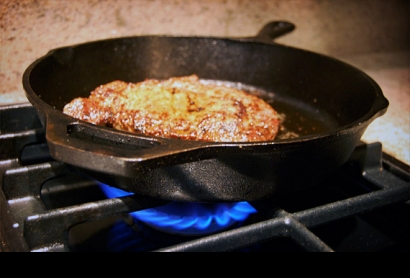
Like I said, this recipe is adapted for use in Buenos Aires ...with the exception being a cast iron skillet is essential.  Essential.  No, your cast aluminum Essen (a SUPER product) will not do.  I have heard, however, that there is an enterprising Argentino who is beginning to cast some very fine iron skillets here. I'll let you know what I hear; I'm on the caper.

Step 1.  preheat your oven to 450° F (230° C)

You can go hotter but you risk blackening your cornbread.  My wife likes that!  Me, not so much.

Step 2.  combine the dry ingredients: 
 2 cups of polenta, 4 tablespoons of 00 white flour, 2 teaspoons of baking powder, 2 tablespoons of baking soda, and 1 teaspoon of salt.  Put all of it together in a nice big bowl and mix thoroughly. Mix, mix, mix.

Yep, polenta.  That's not as strange as it might seem ...good cornbread needs a relatively fine grind anyway and polenta here fills the bill.  I wish I could recommend non-instant polenta ...but I don't think that exists here anymore.  Instant polenta could actually help this recipe, though ...I think it absorbs the wet ingredients quicker.

The white flour is important.  Cornmeal has little to no gluten and you need gluten to get your cornbread to rise.  If I can't find good bread flour, I keep some pure gluten on hand (you can find it pretty easily here in natural food stores) and I add a couple of teaspoons to the wheat flour.  You get more effect and still get to keep the flour down to a respectable minimum.

If the amount of baking soda seems a bit over the top, just wait.  It's essential and it keeps your salt down to 1 teaspoon.

Step 3.  beat 3 eggs

That's more eggs than most recipes recommend ...but eggs also give the corn meal a structure it can use like the high gluten flour to make your cornbread rise and become fluffy and stay a little moister.  Good Southern cornbread should be dense ...but too dense can interfere with your enjoyment.  Grandma was probably lying about only adding 2 eggs, anyway.

Step 4.  make 2 cups of "buttermilk"

Now, if you can find buttermilk in Argentina, good on you.  However, even if you can find it, you might want to "make" it yourself.  Buttermilk adds two things to a cornbread recipe: acid and that cultured/fermented flavor.  The most important thing is the acid.  The acid of the buttermilk will react with the baking soda and cause your batter to foam.  This foaminess, along with what the heat will do to the eggs and baking powder will leaven your cornbread and people will think you're a magician ...or will suspect you have an old family secret recipe.  Stick with the old secret family recipe story.

To "make" buttermilk take your 2 cups of milk and add 3 tablespoons of cider vinegar.  Wait 5 minutes then add the beaten eggs.

Step 5.  preheat your cast iron skillet with 3 tablespoons of grease/oil for about 5 minutes but not enough to make the skillet smoke.

If it smokes a little, that's ok ...but no more.  Since your skillet is black, it's hard to tell when you've burned your oil.  That burned fat could contribute some bad flavors ...of course, if your grandmother always burned the fat, maybe it'll just bring back pleasant memories!

Bacon fat would be the preferred grease ...but that's hard to find here.  Vegetable oil of any kind is fine.  I use pork lard (grasa porcina comestible) but beef fat would be fine, as well.  Butter is problematic because it burns too easily for this recipe ...if you're going to use butter, clarify it to help it handle the high temperatures.  Sometimes, I add a very little liquid smoke to my lard to try to approximate bacon fat.

Step 6.  pour the egg/buttermilk mixture into the dry ingredients 

Mix the wet and dry ingredient together very quickly ...but not brutally.  Don't beat them together like you were whipping cream, just mix them gently so that there are no clumps of dry ingredients.  You may notice some foaming ...that's nice.

Step 7.  pour the batter into your hot skillet

Don't let this step baffle you.  The skillet is not there to cook your cornbread.  You only want that unbeatable thermal mass of the cast iron to give your cornbread a head start on baking.  Don't try to "fry" your cornbread on the stove top for a while before placing it in the oven.  That won't achieve anything except to increase your chances of cornbread burned on the bottom.

This recipe assumes a 10 inch (25cm) skillet.  What you're trying to do here is fill your skillet almost to the top ...so that your cornbread won't look so much like a tortilla or fallen souffle.  Cornbread doesn't rise like wheat bread; it won't overflow your skillet in the oven.  The batter's depth in your skillet will be about the height of your result.

If your skillet is larger (lucky you!) you may want to augment this recipe.  If your skillet is smaller, you're also in luck ...any left over batter can go back into your hot skillet, with a smidgen of oil, to make deelicious pancakes, hoe cakes, johnny cakes, journey cakes ...whatever you wanna call them.

Step 8.  place your hot, batter-filled skilled into your preheated oven

Careful, now ...that skillet is hot and your oven is hot.  Goof up and you could hurt yourself or others around you.

Leave it there for 20 minutes.  That seems to be the magic number of minutes.  The already HOT iron skillet starts helping it to bake immediately.  You're looking for the careful balance of making sure that the center of the batter bakes solid ...and to making sure that your cornbread doesn't burn on the bottom.  Your oven rack placed half way up seems to give the best results.

Don't get paranoid, corn meal can take a lot of heat ...and there really isn't much else in this recipe.  Your cornbread should not be a pale color on the outside.

Step 9.  take the skillet out of the oven and let it cool slightly

I'm always afraid of letting the cornbread cool too much in the skillet ...a little bit is needed for it to release but too much and I'm afraid it will stick.  If your skillet is well-seasoned, it might just pop out like it was teflon once turned upside-down.  If it doesn't, just gently pry it from the upside-down skillet with a small fork.  That's probably just me being paranoid ...I've never had any problems.

Step 10.  eat some cornbread!

Cornbread and buttermilk, country-boy's delight
I eat in the mornin', I eat it noon and night.
Some peoples like fried chicken
And others likes the HAM
But cornbread and buttermilk makes me what I am.

If you are lucky enough to have buttermilk, go ahead and dunk it and dip it in a cold glass.  Otherwise, just slather some sweet cream butter on it right out of the oven (it doesn't need to cool like a cake.)

I think chili always tastes better with cornbread ...or you could do MY favorite and serve it with YOUR favorite bowl of beans.  Way yum.

Once you've gotten comfortable with this recipe, don't hesitate to play around with it.  Adding cheese and hot peppers and maybe a little cumin to the batter is a great variant.  Bacon (of course!) or any smokey meat would be welcome just about anywhere with any sense.

Don't forget what I said about making pancakes from the batter!  Just do the same skillet/oven routine ...but cut back the baking time to more like 10 minutes ...and keep the oil/fat/grease to a minimum.  No more boring pancakes!  And if you're a dyed in the wool Yankee, some butter and maple syrup will stoke you for heading out to work in the cranberry bogs (hmm... some cranberries, too?)  These pancakes rival fried cornmeal mush!  You might choose to forget about making cornbread.

Well, that's it.  I made only sucky cornbread all my life.  The cast iron skillet is the key ...and those are hard to get a friend to mule down to Baires for you.  On a serious note, however, I truly am following up a lead on a guy here who is forging black iron for our kitchens ...if that's true, I'll be sending him a bunch of customers.

Provecho!
Mike

Wednesday, February 18, 2015

Raicilla! Ay! Qué Rica!


This one goes out to my Uncle Dick.  He and my Aunt Susie are probably the biggest reason I emigrated to Latin America.  Back in the 80's, they took up the expat life in Jalisco, Mexico ...with the big difference being that they tended to stay away from foreigners and cultivated beautiful relationships with the locals.  After their arrival in Mexico, I went toe-to-toe with my then-intense fear of flying and escaped the Chicago winters for two weeks every January.  Through them, I visited homes of their friends in the hills above Puerto Vallarta and came to love Mexico as much as them.

One morning, while preparing a late breakfast, I remember (I'm cursed with total recall after alcoholic bouts) there was a knock on the door.  My Uncle Dick went to answer it and, after a brief discussion at the door, he came into the kitchen with a quart bottle of something that looked like water.

"Hey!  You know about this stuff?"
"No.  What's that?"
"That's raicilla, baby.  You ever heard of it?  You want some?"

I'm pretty sure I'd swallowed some of the freshest eggs and butter in the world ...or I would have begged-off.  As it was, we poured some shots and I sliced-up some limes.

 "Careful, now ...it's strong," he told me.  This was from a man who I'd never seen advise caution to anyone regarding a distilled spirit.  If YOU couldn't take it, that was just tough shit on your part.

"What is it?"

"Raicilla.  Moonshine tequila from up in the hills.  It's good but it's not easy to get.  You got to know somebody.  This stuff is particularly good."

I sniffed the shot glass and it smelled good ...but strong!  I squeezed a wedge of lime into mine in the hopes of ...I don't know ...and steeled myself ...and took a slash.

I didn't taste too very much but what impressed me was that, for all it's strength, I didn't cough or choke ...it was barrel proof and had numbed, anesthetized my throat.  It went down smooooth.  That freaked me out.

"Well!  Whaddya think?"

Neither good tequila nor mezcal was available in the US in those days.  José Cuervo, this weren't!  Like any good cactus whiskey, the perfumes of the stuff started to swirl up around the back of my pallet and into my sinuses and into my lungs for the next couple of breaths.

"Gimme a second," I said, trying to take it all in so unexpectedly there with the sun streaming in on its way to the yardarm.  "It's good.  Really good."

"It's about 140 proof, give or take."

I told him that it didn't really taste that strong ...then it hit me.  I'd never downed a shot of anything that affected me in the tips of my toes before any place else!  Pretty soon, my whole huaraches were tingling.

A couple two three shots later and the afternoon began to dissolve into sun, sand, ocean, and palmtrees.  Beautiful day.

Just a few years later, I read that the actor Richard Burton had become a big fan of the stuff just a few blocks away from my denouement. Ten years later, I was introducing a generation of Chicagoans to mezcales, albeit at a more civilized level of the active ingredient.

Great article!  If you can get it in your city, take a slash and think of the Ol' Yanq and his Uncle Dick.

Salud!

Thursday, January 29, 2015

Eat the Can

 "The king of canned plant products is the canned tomato. Tomatoes are the ideal use case for canning: a product with a very minimal harvest time is picked at its peak and preserved, so I use canned tomatoes ten months a year, happily. The only time I opt for fresh tomatoes is during the tiny window in summer when the New York, New Jersey, and Pennsylvania fruits are at their peak. There are lots of variation in canned tomatoes. They usually come in either whole, chopped/diced, crushed, and pureed/sauce. Go for the whole ones and cut to your liking. My favorite trick for turning whole canned tomatoes into a puree is to jam my immersion blender right down into the can and go nuts. No extra cleanup!"

Tuesday, June 10, 2014

$7 Dollar California Broccoli?

As my wife likes to point out, when you export agricultural products, you are exporting water.  If you've been following the extraordinary drought in California, you'll know that water matters there are bad getting worse getting disasterous.  Mother Jones has a great write-up on how your food budget could change in a big way ...and how you may be getting your fruits and veggies from somewhere else.

You might want to brush-up on your gardening skills, too!

Saturday, May 17, 2014

Brewing Beer on the Ranch

Well, the frost is on the pumpkin and the hay is in the barn ...and the Yanq now longs to ramble along, stumbling 'round drunk down on the farm.

After the historically hot summer, agrarian work is ending and temps have cooled to beer brewing temperatures ...and I aims to make the most of it.

It is rustic, I must say ...but since beer has been brewed cheerfully for about 4000 years in all weathers and conditions, I think that we'll be able to churn-out a brew acceptable to any working man or woman.  I do believe my brewhouse could use a good old-fashioned scrub-down, however.  I'll get to it.

This time out, I'll be giving a couple of relatively new methods a try ...both, strangely enough, originating on this South Side of the Planet.  Australia, specifically.

First, in order of battle, is the BIAB (brew in a bag) method ...and many thanks to the world-wide community devoted to exploring this time and work-saving method, not the least of whom are the BIAB facebook group.

Those of you who know how to take malted barley grains and turn it into beer won't fail to appreciate how this method simplifies the process ...athough it is still new enough to engender controversy.  Those of you who have no idea how yer cold one gets from feed-sack to frosty glass will just have to trust that there is something new and magical.

And time and effort saving!  Yea!  This new method saves hours and days and has been producing award-winning beers.  Those savings free the mind from drudgery towards more creativity ...and making more beer!

Another VERY Australian method, is to cool the pre-fermented beer in a food-grade jerry-can instead of using a radiator of cold water or dunking in ice ...more inside baseball, I know, but another antipodal and extraordinary innovation for folks that like to make beer for themselves.  "Oztrayan as a shit sammich," an Aussie friend once described it to me ...and perfectly suited to our lack of serious refrigeration on our un-electrified ranch.

Why make beer for yourself?  Good question, if I do say so myself.  Well, it's better ...and it can be tailored to your preferences ...it dovetails so very nicely into self-sufficiency ...and can be cheaper, although beer is about the last cheap thing here in the Argentine peso economy.  As a dirt-ranchin' resident deep in the recesses of the mighty Pampas, I can also tell you that it saves me a rediculously wasteful trip into town ...when all I need is a few cold ones.

Another good reason to brew beer in Argentina is: this is not a great beer drinking country.  Things have changed substantially over the past 10 years but, the general rule is still, "if it's good, it's hard to find and expensive ...and if it's easy to find and affordable, it's not very good."  Making your own beer changes all of that ...and could save you a 25km dirt road trip into town for a Quilmes.

But here's another REALLY good reason to brew beer in Argentina: great barley and barley malt ...and we owe it all to one man and his sons:


The Bembergs systematically made Argentina into the beer barley powerhouse that it is today.  Other than the cultural preference for wine and a general prejudice against public drunkeness ...there is no substantive reason for Argentina not being a beer powerhouse, as well.

If you've read this far, I'll give you the recipe for what got into my fermenter right now:

I started with a 50 liter kettle of 41 liters of water (10.83 US gallons) heated to 72°C/160°F

Then dumped into it a mesh bag containing:
4.66 kilos of pale malt (10.27 lbs)
2.68 kilos of pilsner malt (5.91 lbs)
0.66 kilos of melanoidin malt (1.46 lbs)

Mashed at 66°C - 67°C (152°F - 154°F) for 90 minutes

Boiled for 90 minutes,
adding 15 grams of Cascade at 60 minutes,
adding 15 grams of Goldings at 45 minutes,
adding 5 grams of Cascade at 15 minutes,
adding 5 grams of Goldings at flame out.

Adding 1 whirlfloc tablet at 5 minutes.

Yielding: about 29 liters (7.66 US gals) of extract.

No chill 14.5 liters each in two 20 liter (5.28 US gals) cubes.

Fermenting each 14.5 liter (3.83 US gallons) batch in 20 liter (5.28 US gals) plastic buckets with airlocks using 1½ packets of dry SAF-05 each.

Too much inside baseball, once again.  However, if you know how to brew, it's informative ...and if you are interested in brewing, even in tight city situations, there might be a few cues for you within the recipe as you find your way through your first few batches.  This method has allowed people in cramped urban situations to brew batches as small as one-gallon.

The frost on my pumpkins is both a blessing and a curse, however.  Not only do I lack modern refrigeration, I lack central heating back at the ranch. Chilly temps are good and preferable for fermenting beer ...but they extend the time necessary to bring grain to glass.

I'll update you in about 3 weeks and ...if you care to venture to Barrio Retiro, I'll do my best to serve you a glass and take notes from your critique.

Na Zdrowie,
Mike

Friday, July 05, 2013

Emergency Hot Sauce

Does hot sauce make you cry?  For me, the LACK of hot sauce makes me cry!  I can't say that I use it on everything ...but I use it a lot.

If you are in a city (even Buenos Aires, nowadays) you won´t have any trouble popping-out for a fine bottle of pepper.  However, down on the ranch, I'm 200 miles from anything acceptable.

The Yanq is, however, pretty careful with his stores and supplies ...so there is always some capiscum stashed away somewhere.  But some things need a dash of liquid pepper rather than a pinch.

Whaddya do if you only have ground red pepper and you wanna make a splash?  Can you make a hot sauce from powdered peppa?

Sí se puede, señora!  After perusing the internet on my trusty, tiny, Blackberry screen ...I found a few recipes and girded my loins for a try at making a bottle out of an envelope.

It worked out great!  I reckoned that all the recipes generally called for a teaspoon of ground hot pepper to every 100ml of liquid ...then the addition of something sticky and rather sweet.  Salt and additional spices can then be added to taste.

I rummaged around and found a hermetically sealed mylar envelope of ground habanero pepper from god-only-knows how many years ago.  Since I love old bottles, there's always something cool in that regard ...I chose a neat old apothecary bottle of approximately 300ml.

As to the sticky-sweet component, I thought about the fruit preserves and other things I'd read in my research ...but since we are surrounded by beekeepers in the campo, I thought I'd avail myself of some of the wild honey that someone gifted me with.

Since I wasn´t sure if the stuff wasn't headed for the drain ...I didn't get too fancy with spices.  I had some nice garlic powder so that and some salt was all I was prepared to bet on this long-shot preparation.

The liquid, I decided, would be about 3 parts apple cider vinegar and 2 parts water.  I knew I would need some acid but I wanted pepper not pucker.

So here goes my recipe for 300ml of hot sauce:


  • Grab a saucepan and add 120ml of water and 180ml of cider vinegar.
  • Warm the liquid to almost boiling.
  • Add 2 teaspoons of honey and stir until it melts into the liquid.
  • Add 3 teaspoons of ground hot pepper.
  •  Add a teaspoon of garlic powder.
  • Add a teaspoon of salt.
  • Stir well and let the mixture return to room temperature.
  • Pour into a bottle and cap it with a good stopper.
  • You're done.

Sheesh!  That stuff is HOT.  Not too acidy.  The sweetness is detectable but not overly so.  The garlic is probably doing a lot to round-out the taste ...but no one would guess it was an ingredient.  Just enough salt to bring up the flavor.

The color was exactly the color of the pepper: more brown than red.  Very whiskey-colored but muddy not translucent.  Other ground habanero powders I've had were screaming red ...I´m pretty sure that would make a fine red colored sauce.  I was really surprised that 3 teaspoons would completely color the sauce and not end up looking weak and somewhat clear.

After a few hours, the solids separated and settled to the bottom ...but still the liquid was fully colored.  All the recipes say that the stuff gets hotter and hotter with time.  Maybe I should filter the mud out after awhile!

Don't worry, Alan!  The Aeropress is safe!

Anyhoo, I won´t be giving up on store-bought and hand-crafted pepper sauce ...but it's nice to know that in a pinch, I can get a splash.  If you try the recipe, lemme know how it turns out for you!

Sunday, January 20, 2013

Argentine Beef is Back?

Hello and happy 2013 to all you fans of sweet, grassy, richly buttery, invigoratingly bloody, highly mineral, livery and gamy, tinged with a ripe and cheesy full spectrum of interesting flavours all wrapped up in a densely-charred exterior!

I have good news.  Grass-fed Argentine beef is back.

Ahh, the vagueries and vicissitudes of life in Argentina!  Nobody rolls with the punches like an Argentine ...and now, apparently, it seems that you can't keep a good Argentine beefsteak down either.

Only 4 months ago, the Yanq was crying in his beer over the sad sorry sucky state of beef here in what was the Mecca of Meat, the Parrilla Paradise, the Rome of Roasting ...ok, I´ll stop: I Ate Grass-Fed Beef this Week!!!

Welcome to Workaround World where there's always a will and always a way.   

Here's the scoop:

Without revealing too many details, yer humble rancher-blogger was scouting a piece of pampasland for the over-flow of grass-fed cattle from our spread (My Missus won't let me eat any of "her babies.")  My gaucho had spotted a "small" spread nearby with so few cattle that he was certain the rancher must be losing money.  He suggested that we approach him and offer to rent the place.

Long story short, we offered to rent the land and were given the bum's rush.  No deal.  No way.

We couldn´t figger it out ...until we found out that he was a butcher!

Faithful readers will recall how I've been lamenting for a few years as to how all the beef in Argentina, in every restaurant, in every butchershop is all from feedlots.  City or campo, we haven´t had a good piece of beef for so long that we basically gave it up.  On those occasions when there was no alternative to beef, we steeled ourselves for the inevitable disappointment.

Well, we made a surreptious visit to Mr. Butcher-Rancher's carnecería for a whole beef tenderloin.  Lo and behold, after a turn on a blazing-hot cast iron skillet ...Meat of Memory!

Bring your adjectives, this was the real deal.  Keep in mind, the tenderloin or filet mignon or lomo is not known for being particularly flavorful under the best of conditions ...tender, yes ...but great beefy flavor generally generates more from just about any other cut.  No denying it ...this was grass-fed!

What gives?  How is it possible for grass-fed beef to be suddenly available after so long?

"When the going gets tough, the tough get going" should be the economic motto of Argentina.  I really shouldn't have been surprised.

Here's the explanation:
  • 1st, soy and corn pushed grass-fed cattle off the pampas and into the feedlots.  
  • 2nd, feedlot beef became the only beef available anywhere.
  • 3rd, high grain prices and grain shortages pushed-up the price of feedlot beef.
  • 4th, butchers began to lose customers to chicken, veggies, and pasta.
  • 5th, not every acre of cattleland is suitable for soy and corn.
  • 6th, small pieces of pastureland became available for rent very cheaply due to not being suitable for grain nor large enough for a cattle operation.
  • 7th, those with slaughter, meatcutting, and retail facilites decided to cut-out the middleman (the feedlot) and are renting these small pieces of land very cheaply, raising the cattle the old-fashioned way.
  • 8th, and best of all, they will sell that beef to you!

Now, none of this is strictly legal. HELL, it´s not even loosely legal!

Slaughtering cattle on your own land for anything other than your own personal consumption has been illegal since way-back in the days of Evita y Juan.  I would never do it ...I OWN my land and would be afraid of losing it in a criminal proceding.  I also don´t have any easy retail capability.  The butcher-ranchers, on the other hand, are only renting.  The only thing at risk is a classic Argentine butchershop that is headed the way of the payphone otherwise.

However!  If this sort of genius is what it takes to bring back the beef, I´m gonna start eating again and I'll raise my glass of malbec to anyone willing to run this runaround!

Conclusion: if you happen to be deep in the pampas, grass-fed beef is available again in small-town butchershops.

How long could it take before it makes its way to Capital?

Wednesday, November 14, 2012

Turkey in November in Argentina

"Dear Yanqui Mike,
I saw your post about fresh turkeys, which I am assuming was written awhile ago. However, are you still able to get fresh turkeys? If so I am interested in probably at least 2 turkeys. Please let me know if this is possible, as I am hosting Thanksgiving dinner for about 30 people next week! 
Thanks so much!
(name withheld)"
Dear Reader,

Here´s the deal on fresh turkeys in November in Argentina:

(Full disclosure: every year I say this someone pops out from behind the nearest jacaranda and says, "I NEVER have problems getting fresh turkeys in November!")

We eat turkeys in the autumn in the US ...here too.  November, however, is the springtime here.

In autumn, turkeys that have been fattening for months on lots of lovely natural things are ...well, fat!

In spring, turkeys are skinny from the winter and, if they are hens, are settling down to a nest of eggs.  Turkey farmers are very reluctant to pull a hen off a clutch of eggs and kill her.

Most people prefer a hen (female) to a tom (male) turkey ...or so they say.  Hens are supposedly fatter, more tender, and with a better flavor.

I would suggest getting a frozen turkey here in November.  As long as it was well-frozen and maintained below 0°F, it would taste better than a fresh turkey here in November.

In fact, without any evidence to support it, I suspect that any good-tasting "fresh turkeys" you can find here in November have been frozen since last spring ...so why pay a fresh-premium for a thawed frozen turkey that you could buy at any big supermarket for much less.

Yours in art and labor,
Mike 

Sunday, October 21, 2012

Weather and the Wheat Police

Brace yourselves, Earthlings.  Agriculture is poised to let you down.

Consider bread.  Even at its most lowely, is hard to replace.  Be it the gleaming white baguette, coarse peasant whole grain, bagels, pita, pizza, or pan lacteo, it is practically in our genetic memory.

As the gluten-intolerant can tell you best, that spongy crunchy loaf is difficult to replicate without the staff of life ...although billions are spent trying to do it or trying to convince us a suitable substitute has been produced.

Not only does it hold a place on our slow-cookin' tables and our faster food joints, it is central to Old World customs, superstitions and religions.

Here in Argentina, it should be no surprise that some of the world's great bread can be found.  The French composed a notable percentage of the great waves of immigration to these shores in the 19th and 20th centuries ...and you can still find their lingering skills here if you know where to look.

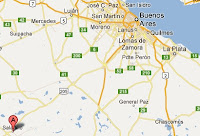
Not that you´ll ever do it ...but if you ever find yourself cruising south of Buenos Aires on Provincial Hwy. 205, stop anywhere in the town of Saladillo.

The culmination of wheat, water, wood and wherewithal in that French-settled burg produces bread that will astound.  If you're in a hurry, just stop for a choripan at the open-air parrilla by the rotonda.  I guarantee that you won't complain there's too much bread.

Argentina is a major breadbasket for planet earth and has been for more than a century.  Although 21st century exports have been spotty, exports will drop by 55% from last year.  We´re still in the top ten for 2013, though:
Keep in mind though, many countries produce wheat but few export it to any great degree.  Most wheat growing countries can't grow enough to satisfy their own population.  You're looking at the lucky ten when it comes to daily bread.

Still, that's lot of exports, no?  I guess the question should be, "compared to what?"

Well, let´s look at the same Top Ten compared to last year:
That's a lot of red ink there.  It might turn out to be even worse with The Ukraine announcing yesterday that they will substantially curtail their exports.  You can see Russia and Argentina doing the same thing.

Weather plays a big role in the drop.

Australia's drop is due to drought ...like Russia, Kazakhstan, and Ukraine.  Argentina is coming-off one of the wettest winters on record after one of the it's driest summers ...too dry for good production, too wet to get machinery into the fields for good harvest.

Along with the weather, however, comes protecting supplies.

Curtailing wheat exports by law is just human nature in the face of shortage.  After all, it´s natural to sell your extra stuff to other people ...but when you are running short of those same things, it´s natural to stop even if those other people are driving the price of your stuff through the roof.

If your spouse loves bread, for instance, you could catch some serious hell if you sell all of it ...no matter what your neighbor paid you!

But protecting your supplies can be very tricky for the guy who actually makes/grows those supplies.  When Argentina started restricting/prohibiting the export of wheat, many wheat farmers were caught with no internal buyers (we had too much wheat internally) at the same time that those farmers were cut-off from their traditional external buyers.

It took 2 or 3 years ...but many Argentine wheat growers have decided to plant something else, something that is not export-restricted.

It´s not always export restrictions that cause that scenario.  Often, in famine stricken countries that receive foreign relief shipments of grain, the free food causes grain farmers to go out of business ...the relief to the general population kills the last few farmers that need to charge for their produce.

But isn't there any wheat in storage?

Sure there is!  The dawn of civilization can be traced to the first time large groups of humans started to put aside extra supplies of grains.  However, the mentality of just-in-time supply chains and globalism and burgeoning world population has contributed to declining stores of grains:
The stocks of grains on this graph are down from years prior to 2002 ...and now we're getting into critical territory.  The green eating-line is going up at the same time the orange harvest-line is dropping ...at the same time the bar representing how much we have in storage is low.

This is bad news for everyone outside the Top Ten grain exporters ...but it could be bad for everybody.

It´s a push-me pull-you world now in agriculture. "No corn?  Feed them wheat."  "No wheat?  Feed them barley."  "No barley?  Feed them rice." 

When there's a shortage of all of them at the same time, however, you are looking at a world we haven´t seen for a very long time.

Tuesday, October 16, 2012

Las Tortillas de Pancho Villa!

I´m getting Pancho Villa Tortillas delivered tonight!  Woo hoo!  I'm excited.

Lemme tell ya, there are some world-class expat foods produced here in Argentina ...some of them are as good or BETTER than in the Old Country.

These tortillas are one excellent example.

The art of making real corn tortillas is disappearing even in Mexico. The brand-name dried tortilla powders now account for more than half of all tortillas produced there.

Through the strange accident of our expat community ...Gabi and Pablo can offer you better corn tortillas with one phone call or email or facebook message than you could easily obtain in Mexico.

You don´t want to even think about making them yourself!  Raw whole grains are steeped in the old Aztec method, wet-ground, shaped and formed, then cooked on cast iron.

There is no Mexican food without corn tortillas, punto, period, full stop.

Go get yourself some!  Cook-up a pot of great beans.  Slowly stew some pork or beef or chicken with cumin, garlic, and hot pepper.  Grab some cheese and slices onions and tomatoes ...maybe some avocado!

Don´t forget fish tacos.

Your toppings and fillings might not be all that authentic ...but on a Pancho Villa Tortilla, they will be head and shoulders above the lame imitators.

Tuesday, September 11, 2012

The Year in Argentine Beef - 2012

"Be it sweet, grassy, richly buttery, invigoratingly bloody, highly mineral, livery and gamy, tinged with a ripe and cheesy or long-hung farmyardy tang, steaks offer a full spectrum of interesting flavours. All of that wrapped up in one of life's primary savoury pleasure: a densely-charred exterior."
Wouldn´t it be wonderful if the above statement described steak in Buenos Aires ...instead of London. Sorry, fans of invigoratingly bloody, highly mineral, livery and gamy with a densely-charred exterior ...there is no more of that here in the land God gifted to cows.

On the bright side, if you love a great Iowa corn-fed steak, you´ll love the steaks on offer in parrillas large and small all over town.  Argentina's finest steak houses even list dry-aged steaks (unheard-of in the days of grass-fed beef) ...and if you hurry, you´ll love the price.  About half the price charged in Iowa.  (Better hurry in the US, as well.  Prices of beef there are due to skyrocket due to two years of drought strikingly similar to what happened in Argentina in 2008.)

In fact, it's now easier to find grass-fed beef in Iowa than in Buenos Aires!

The sad news is, however, that if you are looking for "that famous Argentine beef", it is nowhere to be found.

This beautiful city and wonderful country still has a million-and-one charms ...but the famous beef which was once a reason for visiting all by itself is now merely a memory.  A memory, that is, if you can remember it.

"The Famous Beef" was very different from the beef that most of the world is accustomed to.  So much so, in fact, that occasionally I would meet an honest meat-eater who would admit to not liking it.  La Carne Famosa lives on, however ...at least in the verbage of tourist touts, the lazy, and the confused/misinformed.

Full disclosure: My Missus and I make a very fine living supplying calves to the Argentine feedlot industry, thank you very much.  It's just that we haven't had a grass-fed steak in years, either ...and we miss it.  And with internal prices being competitive with export prices, we don´t fret much anymore about our beef not making it to tables around the world.

The biggest story about Argentine beef this year is one that even the disinterested may have heard: Argentina's counter-charge against the US in the WTO regarding the import restrictions we here currently are living with.

Specifically, Argentina has brought suit against the US practice of banning Argentine fresh beef and lemons (what rarely gets mentioned is that Argentina is one of the few countries on Earth to which the US exports more than it imports.)

No matter what the legitimacy of the complaint and counter-complaint, the kafkaesque thang is that the lemon crop here was devastated by weather ...and we really don´t have any beef to export.

In 2005 Argentina exported 771,400 tons of beef. In 2011 beef exports dropped to 300,000 tons ...and so far for 2012, we should come in about 30% even lower than last year.

It´s difficult to imagine how we might return to those days in which the world's greatest steak could be found on almost any block.  Until then, eat grass-fed steak in the US before you leave.  Then compare, contrast, and discuss.

Sunday, September 09, 2012

B.A.Underground Market Returns!

Your stop this Saturday!  GET OFF at the second installment of The B.A. Underground Market!

So much to love ...all courtesy of everybody's favorite local newspaper, The Argentina Independent!

Get ready fans of artisanal tastiness!  This Friday is the second installment of The B.A. Underground Market. The last one was in July and was the inspiration for my Expat Eats.  The whole thing went-off without a hitch ...other than hundreds of people all wanting more than they could possibly cram in their pie holes (Oh! The pie!)

Full disclosure: I've never attended an event in Buenos Aires that I enjoyed more or that impressed me more.

I think I stopped counting food booths at around 25 ...everything from BBQ brisket to hand-made chocolates to pickles to cookies to sauerkraut to craft beer to goat cheeses to hot sauces to pecan pies to beef jerky to cake pops to spring rolls to juices and smoothies and yogurt and more.  Around 700 people grazed comfortably in the huge space at IMPA-La Fábrica on what was the coldest day of the year.  Now that the weather is turning springy, I´m sure we can expect more of everything.

Another thing that really impressed me was The Indy's choice of venue.  Long time readers know that Almagro is my favorite barrio ...and IMPA-La Fábrica is a building that will fascinate.  Three cheers for The Argentina Independent for recognizing that expats have expanded beyond our borders of 10 years ago!

Easy access from all parts of town and walking distance from TWO subte stops.

If you missed the last one ...and not many people did ...you really truly owe it to yourself to get your act together and show up this Saturday. 

Not enough?  How's 'bout HALF PRICE TICKETS!  Instead of 10 pesos per person ...get your tickets for only FIVE pesos each (kids up to 12 years old are free.)

Just drop a line to events@argentinaindependent.com and tell 'em Yanqui Mike sent ya!

See ya there!

This event is a cash event only.
Saturday, 15th September
12 - 5pm
IMPA la Fábrica, 3rd Floor
Querandíes 4290, Almagro

Wednesday, August 29, 2012

Baines Best Bacon, the Bacon of Baires

Vegans, vegetarians, and orthodox religious sects beware: the famed entry-level pigmeat is here.  Real yanqui-style bacon.  Fatty bacon.  Streaky bacon.  Cured pork belly.  Just like back in the old country.

It took me awhile to find the mysterious Mr. Baines, "the Brit with the bacon" ...but it was worth it.

Ordinarily, our British cousins taunt us when presented with our beloved crunchy strips of delight.  They´ll say, this is not "proper bacon" ...prefering bacon from the loin, what North Americans call "Canadian bacon."

Not Heath Baines.  He not only calls this bacon ...he calls it Best.  (Unconfirmed sources tell Yanqui Mike that Baines was spirited away from his uncle's deli in Thornton Heath, UK as a child during the Profumo Affair to live in an undisclosed location in or around Appalachia.)

These are the perfect machine slices that, in a short few minutes, become the greasy oblea of a million American Dreams.  These are the essential B in BLT, the soul mate to your fried eggs, the very soul of Hot Brown, the stuff that you can´t cook in a crowded kitchen because your pile will be pilfered to perdition.

The stuff without which your frying pan's too wide.

So where do you get it?  You don´t.

You get on the list for the next bacon run.  It comes discretly to your door as professionally packaged as Oscar Mayer ...by the pound.  Delivery frequency is about every 3 weeks and he doensn´t like to deliver only 1 lb. (you´re gonna need at least 2lbs., anyway.)  Fry some up in a good stout skillet for your Argentine friends and stand back!

I mostly just munched mine out of the skillet ...but after a couple of BLT's, some bacon & eggs ...and a few deliciously weird tacos made with Pancho Villa's incomparable corn tortillas (Man! Bacon, avocado, onion, lime juice, and hot peppa!)  My Missus was ecstatic.

I´m back on the list ahead of you ...so get in touch with him quick.

$55 ARS per pound (cheap), cash, small bills.
Email vingt-cinq-@hotmail.com and tell him how much you want.
He´ll contact you to say when it will be delivered.
https://www.facebook.com/pages/Vingt-Cinq-Baines-Best-Bacon/166492793374992

Friday, August 24, 2012

La Barata del Central

My Missus came home with a box of this today!  She was tipped-off by our dear friend Marta Motta and happened to catch a short interview with the founders on television.

La Barata del Central is a fascinating concept: the place looks like a farmers' market but you can´t just roll-up and buy some.  You need to go on-line and reserve a box ...or have it delivered at no extra charge.

The idea is based on all the publicity surrounding Buenos Aires' huge Mercado Central and how much cheaper everything is there.  Of course, if you´ve ever tried to take advantage the big mercado, you know how difficult and expensive a trip there can be.  It´s just outside the city limits, public transport is limited and there are several tolls for those who drive.

The idea is similar to some produce subscription services I´ve seen back in the old country in which, for an annual fee, you receive a basket of select seasonal fruits and veggies every month or so.  My Missus reminds me that it also reminds her of the kind of informal groups of friends that used to make trips to Mercado Central during hyperinflation days.

La Barata is different.  You don´t have to subscribe or join a group!  You just go on-line and tell them you would like either a large basket or a small one.  If you are fortunate to live within their delivery area, they´ll schlep it to your door ...otherwise, you can go pick it up at their galpon in Palermo Hollywood.

The produce is definitely seeelect!  The folks at La Barata del Central must be getting to the market awfully early because everything in the box was fresh, tender, and jewel-like.  On their website, they make a big deal of how much cheaper they are ...but they compare themselves to a "corner chino where one potato costs 2 pesos."  There are, certainly, places like that.  However, I´m not sure that they are much cheaper than my wonderful corner greengrocer ...but the wealthiest parts of town (virtually all of them contained in the delivery area) may have priced-out many of their little verdulerías.  I think the "marketing of their marketing" is on a great footing.

And La Barata delivers!  Their delivery area is really big and includes parts of Coghlan, Villa Urquiza, Villa Ortuzar, Villa Crespo, Almagro, and all of Chacarita in addition to the usually well-served areas.

If my big box is any indication, you won´t be disappointed!  Check 'em out here.

Tuesday, August 21, 2012

Cast Iron Update / Recipe Request!

Of course, it's big.  Of course, it's black.  Of course, it's heavy and has a mythic place in culinary history ...but I was unprepared at how GOOD it is!

Factory pre-seasoning had a bad-reputation about 10 years ago ...but this time, I didn´t care.  I bought it anyway.  If the pre-seasoning was no good, I could always throw it into the campfire and burn everything off at about 1000F.  Then, I could try my hand at seasoning it myself.

But WOW this stuff is INCREDIBLE right out of the box.  I experimented with cooking a couple of things ...and they slid right off like teflon.  After 3 or 4 uses, I fried a couple of cackleberries and the results were probably better than non-stick!

Like I mentioned last week, I don´t know why it took so long for a cast-iron skillet factory to figger-out that THEY were in a much better position to do the seasoning than the average home cook.

I can´t say enough about cast-iron cookware that is non-stick right out of the box.  My Missus is nothing less than thrilled and wants to get rid of all our teflon stuff.  I never thought she would even like it!  For her, I think, the conversion occurred when she "roasted" some bell peppers on the hot iron.  That incredibly high heat really did something to cause them to be way more flavorful.

NOW I REALLY NEED YOUR HELP:  Do you make great cornbread?  Do you have a recipe that is not a closely guarded family secret?

My cornbread sucks ...always has.  I´m a good cook, maybe even a great one ...but there are a couple two three things that elude my abilities.  I guess that if you can´t find it in an average restaurant kitchen, I´m no good at it (e.g. I was almost 40 before I mastered cooking over a an open-fire.)

Full disclosure: although my Yankee pedigree is impeccable, I prefer Southern cornbread.  I have to agree with my otherwise misguided rebel brethren that, up north, it's too sweet and too wheat-floury.  I prefer cornbread that is savory and gets its sweetness from all the butter I intend to slather it in.

Even more specifically, the recipe should include the necessary step of beginning the process in a cast-iron skillet on the stove top.  Oven-finishing, is OK.

Of course, here in Argentina, during a world-wide corn crop failure, I may be forced to use whatever cornmeal I can find.  Please include how finely or coarsely the cornmeal should be ground ...I´ll take it from there!

Thanks in advance ...and, if you wanna, you can follow my efforts on quora.com!