Showing posts with label feature. Show all posts

Thursday, July 30, 2015

YM Fermentation Week - Sandor Katz

Dance wit' da one who brung us all, Sandor Katz!

In this GREAT video from the New York Times, you get a real feel for the man who was decades ahead from the rest of us as regards fermenting veggies ...and imparting all that wonderful probiotic goodness to foods that might rot in a bad way!

Do you have his book?  I've had it for years and it is considered the bible of fermentation.

This book will take you through the basics to the finer points of the fermented veggies you know ...to some you've never heard of.

They don't call it the bible for nuthin'.

Get it anyway you can.  If there is a food preservation book that is indispensible, this is it.

Sauerkraut is the gateway veggie to blissful preservation and keeping Vitamin C levels up all winter long way out in the country.

Wednesday, July 29, 2015

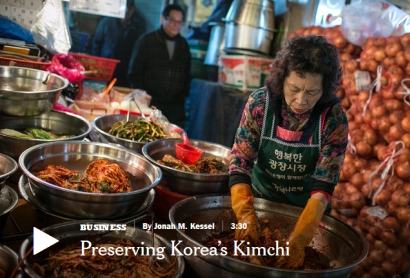
YM Fermentation Week - Kimchi

Here's one I haven't tried to make yet, Korean kimchi, calling it the "sauerkraut of Asia" doesn't begin to describe it.  I've always known that it was important to Korean cuisine but I had no idea how important kimchi is to the culture as well.

Wherever Koreans go, kimchi will follow be it in war or the peace of outer space.

I love the stuff and intend to make up a big test batch.  I love this NYT video, too!

Tuesday, July 28, 2015

Watermelons ...then and now!

I hope I can do more of these.  A lot of vegetables have been inbred beyond recognition ...some for better, some for worse.  Examples like this are fascinating at any rate!

Stanchi's watermelon, which was painted sometime between 1645 and 1672, offers a glimpse of a time before breeding changed the fruit forever.

Tuesday, July 14, 2015

A Special Request...

...could you snail mail me some seeds?

Yer ol' clod hoppin', dirt gardener, da Yanq had such a disastrous last year.  Not only did I not have any seeds to save ...but I actually swore-off gardening altogether.

If you are a gardener, maybe you can relate.

Anyhoo, I usually get seeds from friends visiting Buenos Aires ...but I told them all "NO" this time around.

Now, I'm having second thoughts.  I'm thinking the weather won't be as wet ...there are ways to get my seeds started earlier ...and I've done some BIG research into organically keeping my destructive ants at bay!

Well, I'm reading my seed catalogs ...and my gardener hormones are up and running.  It's late, though.

Not too many of my friends arrive here in Argentina in time for planting ...the weather from now until October is not exactly tourism weather, if you know what I mean.

Seed companies either won't ship to Argentina (their policy) or our customs house stops commercial shipments and holds them for hostage.

So ...if you've got nothin' better to do
Or ...if you've got lots of heirloom/open-pollinated seeds around the house
Or ...if you could just spread the word

...could you dump some seeds into an envelope and address it to me?

Some might fall out.  Some might get held for ransom.  Some might never even make the boat!

But some will make it through and you will be adding to "saveable" seed bank of Argentina.

A packet of seeds is usually too much for my own purposes ...so I always share with my local Argentine gardeners.  They are usually amazed at the deeliciousness of the old-timey varieties that have gone by the by.

Until last year, I intended to start a seed bank here for old-fashioned vegetables ...local gardeners are interested and the little town near my ranch wants to help.

Anybody who can help me out with seeds this year can follow the progress of this seed bank here at my humble blog ...which will be back to life now that I've deleted my fb account!

If you have a PayPal account, I'll reimburse you instantly.  If you visit Buenos Aires, the homebrewed beer's on me!

If this idea tickles your fancy, drop me an email at yanquimike@gmail.com

...and thanks a million ...and consider yourself a founder of the US-Argentine Heirloom Seedbank.

Yours in the dirt,
Mike

EEESPECIAL thanks to my friend Alan from Snohomish WA for scouting down a pack of rare tomato seeds while on vacation in SPAIN. Wow.  You gotta love that.

I Closed my FB Account

Yep.    I finally did it.    You've probably thought about doing it yourself.

What do you call Beef Brisket in down here in Argentina?

This summary is not available. Please click here to view the post.

Monday, July 13, 2015

The Big Garden of 2014 - 2015

What a disaster.  Last year our spring was so muddy we couldn't get even get into our ranch let alone our garden.  By the time things dried up, it was too late ...but I worked it as best I could and hoped for the best.  The best didn't happen.

Then, the ants ...I learned a lot about ants last year while I was, alternately, doing nothing and watching them eat every single thing I planted.  They even ate my rhubarb!!!  All of it!!!  They "killed corn ass-high" as my father liked to describe the destruction of things that were seemingly too big to fail.

I swore off gardening.

Now, however, in the deep of the Argentine winter ...I am beginning to peruse seed catalogs once again.

I begin to dream of gardens-past.  That leads me to dream of gardens-future!

I'm a rancher.  That's different from a farmer.  Ranchers laugh at farmers ...then they REALLY laugh when farmers fail.  Our animals plod along with no fixed schedule of harvest and they load themselves onto the trucks when the time comes to harvest the "calf crop."  There's an old Argentine (rancher) saying that goes something like, "Crops will bankrupt you ...but cattle will keep your homestead for generations."

But I've planted a few crops and a few gardens and, well, sitting by the fire perusing a seed catalog, and thinking of the green of spring and deliciousness of summer and fall ...that gets into your blood.  And since my wife and I are probably more vegetarian than most of you, the thought of colorful, sweet, crunchy, herbal veggies stretching up from the soil is just too much for me to abandon easily.

Rage, RAGE against the dying of the veggies!

After much research, I think I have just the thing to organically keep the ants at bay ...so I have set myself to endeavor again to garden.

I'll keep you posted.

Thursday, May 28, 2015

Chicken-fried Bife

There comes a time when you have to grab the beef by the loins and face the situation!

Bad news: Long gone are the days of flavor-packed grass fed Argentine beef being worth price of the airline ticket.  Today's "pride of the pampas" beef is indistinguishable from feedlot beef from the US or anywhere else.

Good news: It's Cheap!  Argentine sirloin steak will set you back about $3.60/lb versus $8.37 in the US, according to a March report from the USDA.

So ...what to do with a nice, vaguely flavorful, cheap cut of beef?  Ask the Unitedstatesians!  Since the advent of feedlot beef in the 1950s, US supermarket shelves have exploded with powders and potions to give beef flavor.  Although you can't yet find anything like that made here, I think that Argentina is ready to embrace the concept.  I make my own yanqui-style spice blend and carry a secret vial of it on my key chain.

Ready to take it a step further?  Why not try a much maligned regional US favorite, the chicken fried steak.

A favorite of both truck stops and trailer parks, the low regard in which this dish is held is probably due to the cheap, mechanically and chemically tenderized beef used.  Before raising your foodie hackles, however, consider its Viennese and Milanese origins as a veal dish.

So shake-off some flour or bread crumbs from your steak along with your preconceptions and dredge-up a favorite schnitzel or milanesa recipe.  (Tip: lots of black pepper and garlic.)

Wednesday, May 27, 2015

Your Salad Lunches Are Killing American Leather

 
"Diets and droughts have made cattle hide more expensive, creating a leather shoelace crisis"

This is exactly what happened to the leather industry in Argentina after our drought in 2008-9.

(From Bloomberg)
http://www.bloomberg.com/news/features/2015-05-27/your-salad-lunches-are-killing-american-leather

Tuesday, May 12, 2015

Argentine Cheeses: Are We Getting Someplace?

Could the supreme deliciousness of grass-fed Argentine beef have stunted the urge for other flavorful foods here?  Now that it's gone ...could foodie-culture flourish?
My darling wife and I were strolling las callecitas de Buenos Aires today on a few errands ...and we found ourselves in the San Nicolás neighborhood, right across the street from Recoleta.

There's a municipal market there that is a diamond in the rough.  Literally, you could step right by it and dismiss it as nothing special.  Two or three steps in the door, however, and your radar tells you that you are onto something special.
http://www.homestayba.com/#!mercado-municipal-san-nicolas/zoom/c1wln/i44e7v
 It's old and it's wonderful and is protected by the city and the prices can be astonishingly low.  It's right on the Callao subway stop on the D line and eminently walkable from about anywhere in the city's central area.

A lot of the market stalls are empty if you don't get there early ...but even the closed ones are beautiful in a "living museum" way, close spaces with ancient glazed tiles, big refrigerator doors from a by-gone era, old scales and machinery, great thick cutting boards worn inches into their original surfaces by operators in their favorite places.  Old signs advertise things that you just can't get anymore.
Mamon is veal ...which is illegal in Argentina ...but not for any anti-cruelty reasons.
It's open until a little past 7pm and, right up until closing, it is a shopper's delight for fruits, veggies, meats, grains, spices, ...and CHEESES.  I just happened to be looking for a nice melty cheese and my sweetie reminded me of this market.

Wow.  I was dumb-struck, gob-smacked and oh so pleased by a cheese I found in the cheesemonger's case (I even forgot to write-down the name of the stall or take a picture!  No worries, it's on the right, immediately inside the main lobby, forward and to your right.)

https://lodepepe.wordpress.com/portfolio/quesos-rebleusson-de-alta-saboya-a-suipacha/
Queso Rebleusson from Fermier
It was pretty.  It looked like it would melt nicely.  I told my wife that I wanted some and, while I had my back turned, she had finagled a big sample slice for the two of us. Wow, it was good.

The cheese lady told us that it was a type of camembert; it wasn't but I could tell from the smell that the inspiration was there!  It was firm but with a little gooeyness.  So far, so good ...but the taste!  There was real flavor in this Argentine cheese!

I don't trust my taste buds after over a decade in The Argentine.

People are always amazed that I emigrated here from the US; people are always amazed that I've stayed here so long ...I'LL TELL YOU WHAT AMAZES ME: of all the countries on earth, how did I pick the one with the most bland version of western hemisphere food?

At least we USED to have the best beef on earth ...now even that's gone.

When I bit into that cheese I wasn't really sure if I was a good judge of cheese anymore.  So I ran it by my friends in the Argentine facebook group, "Buena Morfa Social Club."  Sure enough, the feedback fed-back immediately.

While "the foodie" may be ready for burial in the US (à la the hippie,) awareness of food is just now blossoming in Argentina.  The Buena Morfa Social Club is a group that started here about a year ago ...it now has well over 12,000 members with no end in sight.  Within an hour, the group sent me enough links and references to the cheese in question to satisfy me that my tastebuds had not atrophied, lo these many years.

Even the cheese lady told me the story of how this particular cheese factory had sent its sons to study in France in order to bring back interesting cheeses.  This is not the Argentina that I grew to love back in 2000.

For example, here's another Argentine website devoted to food, Planeta Joy ...the link was sent to me by the group and, sure enough, it mentioned the cheese I found today.  Not only did the post mention my cheese, it raved about it and how strong it tasted:

Extreme Cheeses: The Strongest of the Shopping Cart
There is a minority of dark palettes that worships mature, aromatic, tasty and powerful cheeses. For them, this post: a tasting of the best examples produced locally.
 Rebleusson: for the audacious
Originally called Reblochon, but the manufacturer, respecting French appellation laws, changed the name to Rebleusson. The crust has a pale orange color, is oily, a semi-soft cheese and when ripe is extremely aromatic, to the point of being stinky in some cases. But this stench is not consistent with its flavor, since taste is less aggressive and has notes of butter and nuts. This shines in the cheese and goes very well with fruity white wines. Perfect gift for a foodie friend or to avenge someone who owes you money by hiding it in a trunk. It is the only example of this cheese in Argentina and Fermier makes it with whole milk from their own Jersey crosses in the town of Suipacha in Buenos Aires province.

Foodie-ism took a long time to take root here ...but it is now here in force.  Now, just like in the US and Europe, ordinary people who have no idea what they are talking about will challenge each other to cyber-duels over foods they have never tasted!

"It's a good thing," as Maya Frost Martha Stewart would say.  We are on our way here in Argentina to more authentic and mindful versions of foods with more of the original flavors of the myriad of immigrants to this bread-basket of the world.

It used to be just beef here. While I lament the passage of that great grass-fed patrimony into history, if its disappearance has resulted in a sudden national craving for other foods with deep distinctive flavors, I'm all for it!

Provecho a todos!

Monday, May 04, 2015

VPN for Expats in Buenos Aires

Solve Your Content Issues with a VPN

News happens everyday, and there are various media outlets that report on this news. However, depending upon  your location, you may find that you cannot access other views of the same news story. This is common in areas which may have limits on what citizens or expats in the area can view. In addition, there are several Internet sites that are geo-restricted. Meaning, if you do not have an IP address of that country, you are not gaining access.

There are also times in which certain television shows come on, and you cannot access them since you are not in the country. For example, shows on the BBC cannot easily be accessed if you are outside of the United Kingdom. However, there is a way to solve both of these issues.

A VPN, or virtual private network,  is a method that many people are turning to these days so that they can watch whatever they want, from wherever they are, and ensure that they can access any website they desire.

How Does a VPN Work?

The main question that users ask is just how is this VPN going to work? It is simple, when you go with a best VPN provider, you gain access to their network of IP addresses that are available. These IP addresses allow you to gain access to information that is based on your IP address. For example, while in Argentina, a person could connect to the Internet with an IP address that is based in the United Kingdom. In doing so, he or she, is going to have access to the BBC and other UK shows or Internet sites.

Other Benefits of a VPN

Besides gaining access to content that you would otherwise not be able to get, which for many is the main reason they use a VPN, there are other benefits that a VPN offers. For example:

  • The IP address you utilize is anonymous, meaning you can avoid security threats that linger on the world wide web
  • Some people have stated that when they use a VPN, they actually see an increase in the speed of their Internet
  • If you have a VPN, you can save on your phone bill as well since you can use a VOIP to make calls, and with a VPN, you can avoid long distance fees
If you are tired of living a life that is full of Internet restrictions, one sided news casts and the inability to watch the shows you wish to watch, then a VPN could be the solution to your issues. There are numerous providers on the market, that all offer a way to get your very own VPN.

Monday, April 13, 2015

Yanqui's Southern Cornbread

Yep.  Here's the yanq with his recipe for good ol' downhome Southern cornbread ...adapted for all y'all in Buenos Aires, Argentina.

Now the yanq is a Northern boy ...but I've always preferred Southern cornbread.  What's the difference, you ask?  Well, although you will find quite a bit of cross-over, Southern cornbread is baked without sugar and with a scant amount of wheat flour.

Careful, though.  Other than how to make "real chili", questioning what constitutes "real cornbread" has caused more fists to swing on more than one occasion down South than anything (culinary) I can think of.  This is further complicated by a lot of Southern grandmas who actually put sugar in their cornbread ...you don't want to get your ass kicked by Bubba or his grandma ...or both.  Like religion and politics, keep your cornbread opinions to yourself south of the Mason-Dixon line.  Up North, we really don't care how you make your cornbread.

Northern cornbread is described as "cake" down South.  It's fluffier and sweeter than its Southern counterpart  That's probably due to the greater availability of hard wheat bread flour up North (some Yankee cornbread hardly has any corn in it at all.)  The sweet part probably comes from the molasses and sugar that was our part of the sugar/rum/slaves triangle.

Being a fanatic for grains of all kinds, not to mention the lack of a sweet tooth, my favorite is the savory stuff that Southerners consider one of the icons of their cuisine.

Like I said, this recipe is adapted for use in Buenos Aires ...with the exception being a cast iron skillet is essential.  Essential.  No, your cast aluminum Essen (a SUPER product) will not do.  I have heard, however, that there is an enterprising Argentino who is beginning to cast some very fine iron skillets here. I'll let you know what I hear; I'm on the caper.

Step 1.  preheat your oven to 450° F (230° C)

You can go hotter but you risk blackening your cornbread.  My wife likes that!  Me, not so much.

Step 2.  combine the dry ingredients: 
 2 cups of polenta, 4 tablespoons of 00 white flour, 2 teaspoons of baking powder, 2 tablespoons of baking soda, and 1 teaspoon of salt.  Put all of it together in a nice big bowl and mix thoroughly. Mix, mix, mix.

Yep, polenta.  That's not as strange as it might seem ...good cornbread needs a relatively fine grind anyway and polenta here fills the bill.  I wish I could recommend non-instant polenta ...but I don't think that exists here anymore.  Instant polenta could actually help this recipe, though ...I think it absorbs the wet ingredients quicker.

The white flour is important.  Cornmeal has little to no gluten and you need gluten to get your cornbread to rise.  If I can't find good bread flour, I keep some pure gluten on hand (you can find it pretty easily here in natural food stores) and I add a couple of teaspoons to the wheat flour.  You get more effect and still get to keep the flour down to a respectable minimum.

If the amount of baking soda seems a bit over the top, just wait.  It's essential and it keeps your salt down to 1 teaspoon.

Step 3.  beat 3 eggs

That's more eggs than most recipes recommend ...but eggs also give the corn meal a structure it can use like the high gluten flour to make your cornbread rise and become fluffy and stay a little moister.  Good Southern cornbread should be dense ...but too dense can interfere with your enjoyment.  Grandma was probably lying about only adding 2 eggs, anyway.

Step 4.  make 2 cups of "buttermilk"

Now, if you can find buttermilk in Argentina, good on you.  However, even if you can find it, you might want to "make" it yourself.  Buttermilk adds two things to a cornbread recipe: acid and that cultured/fermented flavor.  The most important thing is the acid.  The acid of the buttermilk will react with the baking soda and cause your batter to foam.  This foaminess, along with what the heat will do to the eggs and baking powder will leaven your cornbread and people will think you're a magician ...or will suspect you have an old family secret recipe.  Stick with the old secret family recipe story.

To "make" buttermilk take your 2 cups of milk and add 3 tablespoons of cider vinegar.  Wait 5 minutes then add the beaten eggs.

Step 5.  preheat your cast iron skillet with 3 tablespoons of grease/oil for about 5 minutes but not enough to make the skillet smoke.

If it smokes a little, that's ok ...but no more.  Since your skillet is black, it's hard to tell when you've burned your oil.  That burned fat could contribute some bad flavors ...of course, if your grandmother always burned the fat, maybe it'll just bring back pleasant memories!

Bacon fat would be the preferred grease ...but that's hard to find here.  Vegetable oil of any kind is fine.  I use pork lard (grasa porcina comestible) but beef fat would be fine, as well.  Butter is problematic because it burns too easily for this recipe ...if you're going to use butter, clarify it to help it handle the high temperatures.  Sometimes, I add a very little liquid smoke to my lard to try to approximate bacon fat.

Step 6.  pour the egg/buttermilk mixture into the dry ingredients 

Mix the wet and dry ingredient together very quickly ...but not brutally.  Don't beat them together like you were whipping cream, just mix them gently so that there are no clumps of dry ingredients.  You may notice some foaming ...that's nice.

Step 7.  pour the batter into your hot skillet

Don't let this step baffle you.  The skillet is not there to cook your cornbread.  You only want that unbeatable thermal mass of the cast iron to give your cornbread a head start on baking.  Don't try to "fry" your cornbread on the stove top for a while before placing it in the oven.  That won't achieve anything except to increase your chances of cornbread burned on the bottom.

This recipe assumes a 10 inch (25cm) skillet.  What you're trying to do here is fill your skillet almost to the top ...so that your cornbread won't look so much like a tortilla or fallen souffle.  Cornbread doesn't rise like wheat bread; it won't overflow your skillet in the oven.  The batter's depth in your skillet will be about the height of your result.

If your skillet is larger (lucky you!) you may want to augment this recipe.  If your skillet is smaller, you're also in luck ...any left over batter can go back into your hot skillet, with a smidgen of oil, to make deelicious pancakes, hoe cakes, johnny cakes, journey cakes ...whatever you wanna call them.

Step 8.  place your hot, batter-filled skilled into your preheated oven

Careful, now ...that skillet is hot and your oven is hot.  Goof up and you could hurt yourself or others around you.

Leave it there for 20 minutes.  That seems to be the magic number of minutes.  The already HOT iron skillet starts helping it to bake immediately.  You're looking for the careful balance of making sure that the center of the batter bakes solid ...and to making sure that your cornbread doesn't burn on the bottom.  Your oven rack placed half way up seems to give the best results.

Don't get paranoid, corn meal can take a lot of heat ...and there really isn't much else in this recipe.  Your cornbread should not be a pale color on the outside.

Step 9.  take the skillet out of the oven and let it cool slightly

I'm always afraid of letting the cornbread cool too much in the skillet ...a little bit is needed for it to release but too much and I'm afraid it will stick.  If your skillet is well-seasoned, it might just pop out like it was teflon once turned upside-down.  If it doesn't, just gently pry it from the upside-down skillet with a small fork.  That's probably just me being paranoid ...I've never had any problems.

Step 10.  eat some cornbread!

Cornbread and buttermilk, country-boy's delight
I eat in the mornin', I eat it noon and night.
Some peoples like fried chicken
And others likes the HAM
But cornbread and buttermilk makes me what I am.

If you are lucky enough to have buttermilk, go ahead and dunk it and dip it in a cold glass.  Otherwise, just slather some sweet cream butter on it right out of the oven (it doesn't need to cool like a cake.)

I think chili always tastes better with cornbread ...or you could do MY favorite and serve it with YOUR favorite bowl of beans.  Way yum.

Once you've gotten comfortable with this recipe, don't hesitate to play around with it.  Adding cheese and hot peppers and maybe a little cumin to the batter is a great variant.  Bacon (of course!) or any smokey meat would be welcome just about anywhere with any sense.

Don't forget what I said about making pancakes from the batter!  Just do the same skillet/oven routine ...but cut back the baking time to more like 10 minutes ...and keep the oil/fat/grease to a minimum.  No more boring pancakes!  And if you're a dyed in the wool Yankee, some butter and maple syrup will stoke you for heading out to work in the cranberry bogs (hmm... some cranberries, too?)  These pancakes rival fried cornmeal mush!  You might choose to forget about making cornbread.

Well, that's it.  I made only sucky cornbread all my life.  The cast iron skillet is the key ...and those are hard to get a friend to mule down to Baires for you.  On a serious note, however, I truly am following up a lead on a guy here who is forging black iron for our kitchens ...if that's true, I'll be sending him a bunch of customers.

Provecho!
Mike

Wednesday, February 18, 2015

"A Cook Abroad"

A little teaser from the BBC series, "A Cook Abroad."  I got to play a small part in the Argentina episode and I'm really pleased at how it turned out.

I even ended up on camera for a few minutes!
MasterChef John Torode really got the feel of preparing and eating good Argentine beef. I was with them all the way to Mendoza and I was astounded at their professionalism and attention to detail.

It's too bad that this series is so difficult to view outside the UK ...but here's a little teaser.  The episode really gives an accurate idea of the state of Argentine beef.

Please let me know if you find an easy way to view this series outside the UK.

Raicilla! Ay! Qué Rica!


This one goes out to my Uncle Dick.  He and my Aunt Susie are probably the biggest reason I emigrated to Latin America.  Back in the 80's, they took up the expat life in Jalisco, Mexico ...with the big difference being that they tended to stay away from foreigners and cultivated beautiful relationships with the locals.  After their arrival in Mexico, I went toe-to-toe with my then-intense fear of flying and escaped the Chicago winters for two weeks every January.  Through them, I visited homes of their friends in the hills above Puerto Vallarta and came to love Mexico as much as them.

One morning, while preparing a late breakfast, I remember (I'm cursed with total recall after alcoholic bouts) there was a knock on the door.  My Uncle Dick went to answer it and, after a brief discussion at the door, he came into the kitchen with a quart bottle of something that looked like water.

"Hey!  You know about this stuff?"
"No.  What's that?"
"That's raicilla, baby.  You ever heard of it?  You want some?"

I'm pretty sure I'd swallowed some of the freshest eggs and butter in the world ...or I would have begged-off.  As it was, we poured some shots and I sliced-up some limes.

 "Careful, now ...it's strong," he told me.  This was from a man who I'd never seen advise caution to anyone regarding a distilled spirit.  If YOU couldn't take it, that was just tough shit on your part.

"What is it?"

"Raicilla.  Moonshine tequila from up in the hills.  It's good but it's not easy to get.  You got to know somebody.  This stuff is particularly good."

I sniffed the shot glass and it smelled good ...but strong!  I squeezed a wedge of lime into mine in the hopes of ...I don't know ...and steeled myself ...and took a slash.

I didn't taste too very much but what impressed me was that, for all it's strength, I didn't cough or choke ...it was barrel proof and had numbed, anesthetized my throat.  It went down smooooth.  That freaked me out.

"Well!  Whaddya think?"

Neither good tequila nor mezcal was available in the US in those days.  José Cuervo, this weren't!  Like any good cactus whiskey, the perfumes of the stuff started to swirl up around the back of my pallet and into my sinuses and into my lungs for the next couple of breaths.

"Gimme a second," I said, trying to take it all in so unexpectedly there with the sun streaming in on its way to the yardarm.  "It's good.  Really good."

"It's about 140 proof, give or take."

I told him that it didn't really taste that strong ...then it hit me.  I'd never downed a shot of anything that affected me in the tips of my toes before any place else!  Pretty soon, my whole huaraches were tingling.

A couple two three shots later and the afternoon began to dissolve into sun, sand, ocean, and palmtrees.  Beautiful day.

Just a few years later, I read that the actor Richard Burton had become a big fan of the stuff just a few blocks away from my denouement. Ten years later, I was introducing a generation of Chicagoans to mezcales, albeit at a more civilized level of the active ingredient.

Great article!  If you can get it in your city, take a slash and think of the Ol' Yanq and his Uncle Dick.

Salud!

Thursday, January 29, 2015

Eat the Can

 "The king of canned plant products is the canned tomato. Tomatoes are the ideal use case for canning: a product with a very minimal harvest time is picked at its peak and preserved, so I use canned tomatoes ten months a year, happily. The only time I opt for fresh tomatoes is during the tiny window in summer when the New York, New Jersey, and Pennsylvania fruits are at their peak. There are lots of variation in canned tomatoes. They usually come in either whole, chopped/diced, crushed, and pureed/sauce. Go for the whole ones and cut to your liking. My favorite trick for turning whole canned tomatoes into a puree is to jam my immersion blender right down into the can and go nuts. No extra cleanup!"

Thursday, January 08, 2015

San Joaquin Protégenos

Annie Cooper was looking outside her kitchen window at another orchard of nuts going into the ground. This one was being planted right across the street. Before the trees even arrived, the big grower — no one from around here seems to know his name — turned on the pump to test his new deep well, and it was at that precise moment, Annie says, when the water in his plowed field gushed like flood time, that the Coopers’ house went dry.

Tuesday, January 06, 2015

Feedlots from Space

Satellite photos of feedlots from artist Mishka Henner.

Wednesday, October 01, 2014

Argentina Running out of Options

(from Soberlook.com)

The old saw, "the taxes on the farmer feeds us all" has never been truer than right here, right now in Argentina.

This is basically an agrarian nation with some impressive industrial capacity.  Make no mistake, however, agriculture pays the bills.

Although the opposite view persists, the chickens are coming home to roost.  During the past few years of extraordinary grain prices, Argentina has been able to heavily tax grain exports in order to fund general revenues.  Soy and corn exports are taxed at 35% of the sale price ...without regard to what expenses were required to produce those grains (beef exports, when allowed, are taxed at 15%.)

Now, the demand for soy and corn has declined ...and this is reflected in its price.  This presents some big problems for a nation that has grown accustomed to financing programs with the proceeds of agriculture.

That might not have been such a big issue had farmers and ranchers and dairy producers felt free to invest their profits into their operations and expand them.

As it is, no agricultural person is investing in expanding their business.  The current decline in grain prices is making this even worse.

If we were truly an industrial nation, we could weather this storm without much trouble.  However, the denial that our exports are mainly agricultural leads to problems that could take years to reverse.

As a socialist, I could never advocate exporting food from the plates of my fellow countrymen for private profit and national revenue ...but to kill the geese that laid the golden eggs here in this beautiful land for so long seems a ridiculous recipe.

Argentina needs the expansion of agriculture here more than ever.  The world needs the expansion of Argentine agriculture more than ever.

Left to our own devices, we ag-types will over-produce ourselves into the poor house.  If, however, buying a new pick-up or going on vacation makes more sense than buying a new tractor or artificially inseminating ...it won't be just us farmers/ranchers who will suffer in the long-term.

Tuesday, September 30, 2014

Yanqui Mike on the BBC

What a great way to spend a month during which my missus and I were rained out of our ranch!

Since about mid-August, I've been an assistant on a BBC documentary, thanks to a referral from Angela of San Telmo Loft (since the crew was staying with San Telmo Loft, I had the opportunity to comfortably lounge around a couple of her properties ...they are wonderful and everything Angela says they are.)

The documentary which is yet untitled devotes its eventual one hour to the state of Argentine beef and eventually ended in Mendoza for a peek at the best drink to accompany a great grass-fed steak (if you can find one, that is.)

What started out as research, turned into an on-camera appearance at the Liniers Stockyards with the host/presenter, John Torode of BBC Masterchef fame ...wherein yer Yanq gets to hold forth from a rancher's perspective.

Then, it all morphed into my traveling with the crew from Buenos Aires to the wine country of Mendoza ...clocking more than 1600 miles round-trip in three vehicles.  Whew.  Those BBC guys are a hard working bunch.

Along with the crew were two local seasoned TV pros, Lalo Lema and Wendy Mata, who both informed me that they had never seen the likes of the production values and professionalism and generosity of spirit shown by the BBC crew.  I was impressed ...but I had nothing in my experience to compare it to.

As for the BBC crew: Richard Sharman, Director; Leila Finikarides, Assistant Producer; Andrew Muggleton, Cameraman Extraordinaire; & Ian Eason, Sound Artist ...I cannot say enough.  Through all the sweat and grunting effort to make the shoot real and worthy of the BBC's standards, every effort was made toward harmony throughout the team ...and what a team it was to watch in action.

The brutal slog to Mendoza and back (once for their recce and once for filming!) could have been unbearable ...but it was a pleasure although a hard-won one.

God, how I wish I had more photos of the wrap party!  Well, we were all too busy to take very many, if you know what I mean.
Dick Sharman, BBC Director

Sunday, September 21, 2014

A Little Patagonia in the Night

http://www.theatlantic.com/features/archive/2014/09/the-entrepreneur-who-wants-to-save-paradise/380116/

“A world-class tourism destination takes a world-class brand,” replied Lehner, a 26-year-old Harvard graduate with dark hair and a chic summer style I wasn’t used to seeing in Aysén: colored jeans and tucked-in tank tops. “It’s not what some guy in Cochrane would suggest. I don’t think Yellowstone’s success was based on what locals thought about it 10 years in.”
 Not exactly like Rockefeller. Philanthopy or meddling, indeed.  You be the judge.